Context
All the requests handled by go servers, might be handled by multiple go-routines. each of the go routines must be aware of request scoped variables such as cancellation.
// A Context carries a deadline, cancellation signal, and request-scoped values
// across API boundaries. Its methods are safe for simultaneous use by multiple
// goroutines.
type Context interface {
    // Done returns a channel that is closed when this Context is canceled
    // or times out.
    Done() <-chan struct{}

    // Err indicates why this context was canceled, after the Done channel
    // is closed.
    Err() error

    // Deadline returns the time when this Context will be canceled, if any.
    Deadline() (deadline time.Time, ok bool)

    // Value returns the value associated with key or nil if none.
    Value(key interface{}) interface{}
}
- The
Doneis receive only for the same reason that there is not cancel function, a context should only be cancelled by the parent Deadline()method determines that a function should start work at all? More on this laterValueis for use by multiple goroutines. But are they secured by locks?- Deriving a context from another context forms a tree, cancelling one context cancels till leafs, and every context has background context which would never be cancelled - WithCancel(parent_ctx, cancel_func) (ctx, cancelfunc) or withTimeout(parent_ctx, timeout) (ctx, cancelfunc)
Creating contexts
The context object can be created in three ways
- basic
- preemptive cancellation
- deadline cancellation (timeout, deadline)
Basic
ctx := context.Context(context.Background())Preemptive
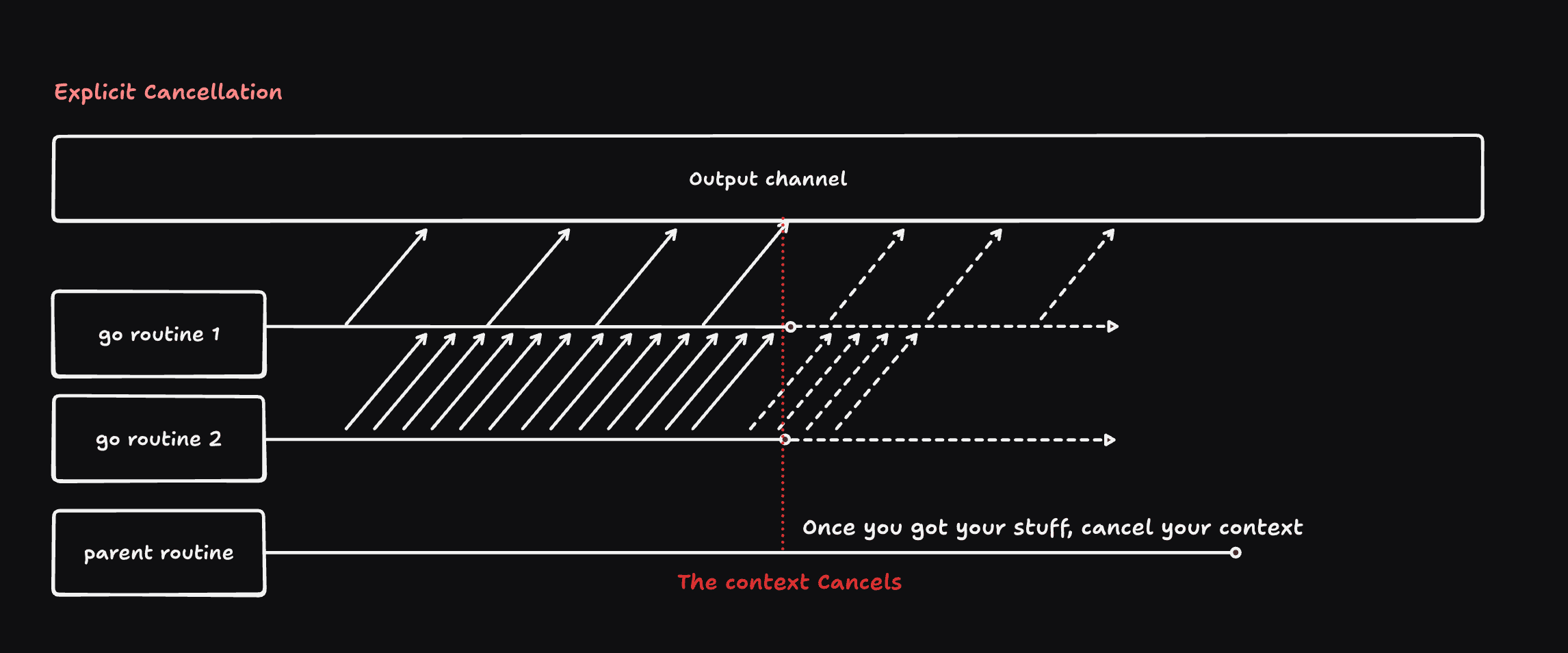 There are cases when a requests that gets handled by multiple go routine making another subset of requests. If one of them fails rendering that you wouldn’t be able to return a valid result, there’s no point in continuing, you can just kill the context by cancelling
Cancel your Contexts
Once you’re done with you contexts, just cancel them. Failing to do so results in resource leaks, subtle increase in memory resources and goroutines leaks
ctx, cancel := context.WithCancel(context.Backgroun())
defer cancel()
deadline cancellation
ctx, cancel := context.WithTimeout(context.Background(), 5 * time.Second)
defer cancel()
// or
ctx, cancel := context.WithDeadline(context.Background(), time.Now())
defer cancel()